


July 29, 2010

Adobe Grant Helps 4-H Youth Get Creative

Youth spend a week learning all about visual arts in the Adobe Youth Voices program with Maryland 4-H in Wicomico County.

Youth spend a week learning all about visual arts in the Adobe Youth Voices program with Maryland 4-H in Wicomico County.

4-H’ers in 14 states will be able to take part in a new program this year that provides them with all of the tools to express their creative genius through visual arts.

Adobe Youth Voices is a program by Adobe, Inc., that aims to empower youth in under served communities around the world with tools to communicate their ideas, exhibit their potential and take action in their communities.

“This is a really great opportunity for the kids that they can’t find anywhere else,” said Amy Rhodes, University of Maryland Extension 4-H Educator, Wicomico County office.

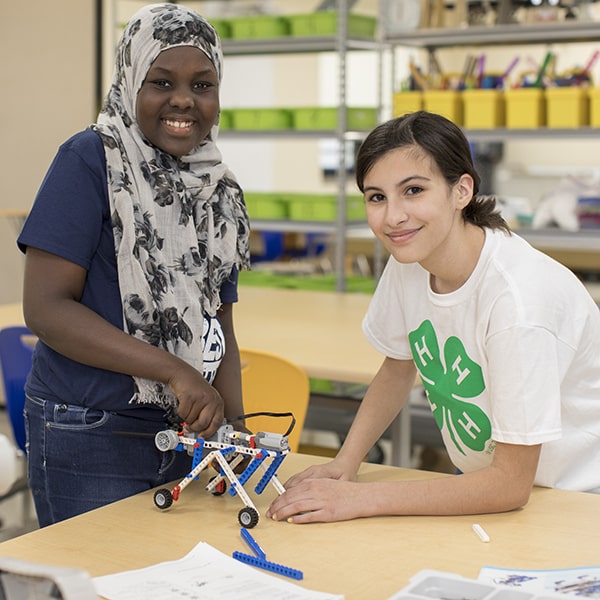
Through a partnership with Adobe, 4-H programs will teach youth about animation, photo essays and movie making, and give them the chance to produce their own piece by the end of the session.

At the summer camp in Maryland, Rhodes has already seen extraordinary work from the program’s youngest member, which she says proves that the success of the youth in the program is not dependent upon talent, but also on their ability to grasp the software.

“The youngest has blown me away,” Rhodes said. “This program and the offerings has had a huge impact on what the kids have put out.”

The collaborative nature of the Adobe Youth Voices program has also supported the growth of team work and leadership skills of the members. Especially for stop animation filming, which Rhodes said sometimes required the help of others.

“They became a unit,” said Rhodes. “All of them had a spark that had me so excited to see what they were going to make.”

The summer camp program in Maryland runs in week-long sessions, and each week is focused on a different topic within visual arts. The sessions are open not only to 4-H youth but also the public, which has been good exposure for the organization in showing others what possibilities are available in 4-H. And Rhodes believes those possibilities are endless.

The Adobe Youth Voices program is now available in select summer camps, and will officially begin in the fall. Given the success of her summer program, Rhodes is looking into ways to make the camp available in an after-school format during the school year.

Visit http://Act4h.weebly.com and click “Artists’ Portfolios” to view the work of these youth.

Adobe Youth Voices is available in these states:
Maryland
Arizona
Oklahoma
Virginia
Arkansas
Colorado
Iowa
Louisiana
Missouri
Nebraska
New Hampshire
New York
Tennessee
Washington

Return to 4-H News


July 28, 2010

4-H Alumna Travels the World with Her Own TV Show

Filed under: General 4-H News — news @ 3:51 pm
acolburn_fish-resized3

Ashley Colburn, host of Taking off... With Ashley Colburn

After her career in 4-H, alumna Ashley Colburn is going places. Literally.

The California native is host and producer of “TAKEOFF… with Ashley Colburn,” a travel show that airs on the WealthTV Network. In the program, Ashley travels the world to explore and experience the lifestyle, cuisine and culture of the affluent.

In June, Ashley won an Emmy award for her documentary, WOW Croatia. She also received the prestigious Gold Pen Award in Croatia for the best television program about Croatia produced in the U.S.

“It all started with 4-H,” Colburn said of her career choice. “Getting up in meetings to give project announcements and general public speaking, I got comfortable talking to people. And I enjoy it.”

She grew up in Fallbrook, Calif., where she was active in 4-H in livestock, leadership and public speaking projects. She held offices as secretary and president of her county’s 4-H Teen Council before becoming a California State 4-H Ambassador in 2003.

After graduating from high school in 2004, Ashley entered Colorado State University to study broadcast journalism. During her senior year at CSU, Ashley started her own entertainment program for CTV “Inside Colorado - College Style,” where she would travel each weekend to a different city in the state to visit local attractions and report from a college girl’s perspective.

Ashley Colburn takes to the sky in Rio.

Ashley Colburn takes to the sky in Rio.

After graduating in December 2008, Ashley moved to California where she briefly worked in media relations for the San Diego County Fair before she secured a position as a host and producer at Wealth TV.

In working with the show, she has visited Croatia, Switzerland, Bermuda, Argentina, Brazil and Tunisia in the last few months.

“I wouldn’t be where I am without 4-H,” said Colburn.

“TAKEOFF… with Ashley Colburn,” will premier in early August on Wealth TV, a network broadcasting to 1 million homes throughout the U.S. and the Caribbean.

Return to 4-H News


July 19, 2010

On 4-H Farm, Microsoft Office Lends a Hand

Filed under: General 4-H News — news @ 2:19 pm

4h_emblem_color_jpg“The only thing that is typical about a farm family is morning and evening chores,” said farmer and 4-H Volunteer Iris Yount in a promotional video for Microsoft Office 2010.

Yes, Microsoft.

Few occasions would bring a farmer and the software giant together, but Yount made a strong case to Microsoft that the products help her family monitor their farming finances, and helps her daughters manage their winning 4-H projects.

The Yount family, from Coushatta, La., were among 50 entrants selected from 12,500 applicants in the Microsoft Office Real Life Stories program. Those chosen were documented in a short video describing how they use Microsoft Office 2010.

“They were intrigued with the farm,” said Yount, who hosted a film crew for the 13 hour shoot. “I served them five to six gallons of tea.”

In the Yount Family Microsoft Video, she explains the benefit of the software.

“I keep financial records on Excel, as far as feed, seed, there are a lot of different expenditures and I can categorize them all and see where the money is going,” yount said.

Daughters Abi and Rena recently won grand championship titles at the Louisiana State Fair, and credit the software available for enhancing the presentation of some of their 4-H projects.

“The girls did a live video of them demonstrating body parts of the goat,” Yount said. “They did it to put into a PowerPoint to make their steer project a lot more interesting to look at.”

She says the girls’ projects are like a small version of the farm. They use the software to learn farm management by tracking the growth and sale of their calves.

According to Yount, this integration of farm and technology is a valuable tool, and can contribute to the success of the next generation of farmers.

“I don’t think there is a farm, no matter what size, that can operate without having knowledge of how to deal with technology.”

Return to 4-H News


July 16, 2010

4-H Students Take Break from Summer to Learn Science

Filed under: General 4-H News — news @ 1:59 pm
summer-science-2010-thursday-037

4-H youth investigate marine and environmental science at Sandy Hook beach in New Jersey

Many high school students take a break from learning during the summer, finding anything and everything else to do besides studying. But for 50 4-H youth from New Jersey, learning was exactly what they wanted to do.

The high school students from urban areas in Bergen, Pasaic, Mercer, Camden and Essex counties were given the opportunity to spend a week on campus at Rutgers University in the 4-H Summer Science Program for Urban High School Students. The experience gave them a glimpse at college life, the chance to learn about science and research through activities with professors and university students.

“The students are very excited about the opportunity to spend a week with Rutgers scientists, touring their labs, learning about their research and how their work is applicable to our daily lives,” Chad Ripberger, Rutgers Cooperative Extension 4-H agent said.

The program is designed to combat the under representation of African Americans and Latinos in the science, engineering and technology fields by getting youth excited about the opportunities that exist beyond medical science.

“Often, youth may decide at an early age that science isn’t for them because they may only think of it in the context of physicians, or they perceive science to be working in a small lab with beakers,” said Ripberger, who explains that science is much more than that.

Throughout the week, the youth were involved in hands-on activities in biochemistry, biotechnology, engineering, and marine and environmental science. They were able to see real-world application through experiments and worked on possible solutions through problems we see today.

“They had the chance to work in a lab with bacterium to find out which would be best to for remediation for the gulf oil spill and why,” said Ripberger. He added that they conducted similar experiments in each of the study areas, and took field trips to Sandy Hook and other places so they could see that research is not just conducted in the lab.

Youth learned about GPS mapping (above) as well as biotechnology, biochemistry, engineering and marine and environmental science while at the Rutgers 4-H Science Camp.

Youth learned about GPS mapping (above) as well as biotechnology, biochemistry, engineering and marine and environmental science while at the Rutgers 4-H Science Camp.

Youth also met with Rutgers students to learn about college life and what it takes to not only get there, but to succeed. At the end of the program, the 4-H’ers presented posters on their studies during a scientific poster session held before the banquet. Their findings impressed family, friends, professors and, according to Ripberger, even impressed representatives from lead program sponsor Tyco International.

As part of the program requirements, the youth have to take what they’ve learned and serve as “science ambassadors” for the younger 4-H’ers in local afterschool programs. They will finish their week of science exploration and college preparation with giving back to their community through service.

“The biggest goal of the program is to get kids excited about science, and it went well,” said Ripberger. “They wanted a second week and to come back next year.”

Return to 4-H News


July 12, 2010

Two 4-H Clubs, One Lamb Tale

Filed under: Citizenship, General 4-H News — news @ 12:11 pm
4-H Members prepare to show sheep with the True Buddies Club.

4-H Members prepare to show sheep with the True Buddies Club.

Members of the 4-H SOS Sheep Club are hard at work in Nebraska preparing for the Sarpy County Fair. While they are busy getting their sheep ready for showing like many 4-H’ers this time of year, these youth are working double-duty to help others who most likely wouldn’t be able to show animals at all.

The 4-H’ers are volunteers with the True Buddies Therapeutic Sheep Club, another 4-H Club where the volunteers work with members who have special needs to teach them how to show animals.

“We were spending all of this time, money and energy, and we thought ‘why not share it with others?’,” said Kathy Mann, SOS Sheep Club Leader and organizer of True Buddies Therapeutic Sheep Club.

The primary goal of True Buddies is to help the special needs youth grow through their interactions with sheep and the volunteers. In the two years since the club was created, Mann as seen a real growth in both the volunteers and the special needs youth.

“The volunteers are more outgoing and have really gotten more confident,” said Mann. “It has really broken down walls for the groups to interact, whether they are at the club or in school or even when they see each other around town.”

In 2008, Katy True was attending the Nebraska State Fair Sheep Show where an unruly ewe named Jewel was having a difficult time in the competition. At the end of the night, members of the 4-H SOS Sheep Club asked Katy if she would like to walk Jewel into the coliseum.

In the True Buddies Theraputic Sheep Club, 4-H youth from the SOS Sheep Club volunteer to help 4-H members with special needs learn how to show sheep.

In the True Buddies Theraputic Sheep Club, 4-H youth from the SOS Sheep Club volunteer to help 4-H members with special needs learn how to show sheep.

It was a risky proposition given that Katy suffers from a Rhett’s disease, an illness that causes deterioration of the brain. Though she uses a wheelchair, she was able to walk Jewel with relative ease and sparked the idea for the “True Buddies” Therapeutic Sheep Club.

“We’ve had amazing results,” said Mann. “Last year, we had three autistic children, who may have had low self-esteem or avoided eye contact. They went out to a standing room only crowd and proudly showed their sheep.”

Some of the special needs youth have learned how to not only walk the sheep, but to groom them as well. Mann believes through their work, the 4-H youth volunteers in “True Buddies” are learning to give more of themselves through helping others, and, in the process, they are making themselves better people.

Return to 4-H News


June 30, 2010

4-H’er Kayla Martell Boldly Faces Challenges, Crowned Miss Delaware

The newly crowned Miss Delaware, Kayla Martell, has been a 4-H’er since she was 5 years old. She credits the skills learned through 4-H with helping her prepare for the future, and face health challenges that might hinder most pageant contestants.

“4-H helped me become comfortable in my own skin so when I was diagnosed with alopecia areata, I didn’t feel like I have to hide the condition,” said Martell.

Alopecia areata is an auto-immune disorder that causes hair loss, and affects more than 4.7 million people in the United States alone.

“Delaware 4-H was where I learned poise and self-confidence,” said Martell. “Sometimes I wear a wig, but sometimes I don’t.”

Kayla Martell appears on the CBS Morning show to discuss alopecia and her Miss Delaware win.  Photo courtesy CBS.  See her appearance on the show here: http://bit.ly/9xn8AU

Kayla Martell appears on the CBS Morning show to discuss alopecia and her Miss Delaware win. Photo courtesy CBS. See her appearance on the show here: http://bit.ly/9xn8AU

Martell competed in support of the National Alopecia Areata Foundation and will continue to support the organization during her reign as Miss Delaware. In 2006, she created a program called Caps for Yaps - Caps for Youth Alopecia Patients. She taught youth how to design and create hats for young people with alopecia. More than 2,000 hats, caps and scarves have since been distributed.

“The mission of 4-H is to be a catalyst for positive change and I can’t think of anyone who epitomizes this better than Kayla Martell,” said Dr. Jan Seitz, associate dean and director of University of Delaware Cooperative Extension. “She is such a force for good in the community.”

Before winning her title as Miss Delaware, Martell devoted more than 2,500 hours of community service to the Health Rocks program, a 4-H curriculum that teaches at-risk youth about the hazards of tobacco, alcohol and illegal drugs. She was inspired to become involved in Health Rocks! ® and other Delaware 4-H initiatives combating youth and teens substance abuse by the loss of a childhood friend to a drug overdose. She even started a group in high school called PLEDGE - People Learning to Eliminate Drugs by Gaining Education.

“Kayla’s life has always been about giving to others and serving as mentor and supporter to those in need,” said Seitz. “I cannot think of an individual more suited to be named the new Miss Delaware.”

“4-H provided Kayla with opportunities that not only enhanced her public speaking and communication skills but helped her to develop leadership, citizenship and community service skills,” said her mother, Rhonda Martell.

Martell is currently a student at Marymount University in Arlington, Va., and will take a year off from school to commit to her responsibilities as the new Miss Delaware. On Jan. 15, 2011, she will compete in the Miss America pageant in Las Vegas.

Return to 4-H News


June 29, 2010

Young 4-H’er Soars Sky High

Filed under: General 4-H News — news @ 12:23 pm
Isaac Kubas prepares to launch his 4-H project, a weather balloon.

Isaac Kubas prepares to launch his 4-H project, a weather balloon.

It was a close call for 9-year-old Isaac Kubas and his year-long 4-H project. Like millions of youth around the country this time of year, Isaac was finishing up his project when he lost it.

“I was nervous,” Isaac said, referring to the moment the GPS went out. “I thought we lost it right then and there.”

What Isaac thought he lost ended up flying 125 miles away from his Austin, Minn., home. There in the field of a Wisconsin farmer was his 4-H project: A weather balloon.

Isaac got the idea from a family friend who saw MIT students working on a similar project. The third grader then did all of the research for the project, including reviewing previous attempts by others and reviewing FAA airspace guidelines, and mowed lawns and shoveled driveways to earn money for supplies.

He only needed a few items: a Styrofoam cooler, Nikon Coolpix camera, Motorola phone with GPS software, 50 feet of rope, a parachute and a weather balloon. Once he had everything, he began to think of the little things.

“I used hand warmers to keep the camera and phone from freezing,” Isaac said. The camera lens was positioned through a hole in the bright orange cooler. It was set to take a photo once every minute.

“I couldn’t comprehend that I took the pictures when I saw them,” said Isaac.

The photos came from 13 miles above earth, 67,000 feet. According to Isaac, a jetliner travels at 36,000 feet.

“I may do this again, but with a balloon that goes up to 100,000 feet or higher.”

Before launching a weather balloon, Isaac started off in the Rock Solid 4-H Club working on projects covering Monarch Butterflies, and how to create paper. His mother, Teresa Kubas, says she has seen a lot of positive changes in Isaac through his 4-H experience.

“As a club, the kids have to make a demonstration to the group that helps them with their public speaking skills,” said Kubas.  “I’m not aware of any other venues for kids that doing this, and he doesn’t even think twice when he has to speak in public.”

“This was a good project,” said Isaac. “It gave me something to do for a long time.”

“4-H is cool,” he continued. “You get to see what other kids are doing, too.”

Although he has some years to go, Isaac says this project has helped him consider a career in aviation. But for now, he’s looking forward to fourth grade, and starting his next 4-H project.

An image of the Earth taken by Isaac's project.

An image of the Earth taken by Isaac's project.

Isaac at the landing site in Wisconsin, 125 miles away (by car) from his home in Minnesota.

Isaac at the landing site in Wisconsin, 202 miles away (by car) from his home in Minnesota.

Return to 4-H News


June 25, 2010

4-H Supports Summer Youth Activity, Education with Let’s Read. Let’s Move.

Filed under: General 4-H News — news @ 5:04 pm

4h_emblem_color_jpg

This summer, 4-H has joined the United We Serve: Let’s Read. Let’s Move. summer service initiative, an effort to keep America’s youth learning during the summer months, as well as keeping them active and healthy.

The program is lead by the Corporation for National and Community Service and first lady Michelle Obama.

“And a lot of kids sometimes find that they forget some of the things that they learned throughout the school year, and as a result, if they stop learning through the summer, they can fall behind and then they’re struggling throughout the year,” said Mrs. Obama at the event launch.

“This summer, though, through United We Serve, we plan to address these problems head on by getting our kids, number one, to exercise. And not just their bodies, but we want you guys to exercise your minds, and to improve what you eat as well.”

4-H is encouraging members and volunteers to support this initiative by encouraging members to participate in the President’s Challenge Active Lifestyle program, and to work in their communities to provide fresh produce to their neighbors.

Suggested ways to help support healthier eating are to start a community garden, and to glean produce. Gleaning involves collecting leftover produce from farmer’s markets and fairs and donating it to local organizations that can use produce to serve those in need. For information on community gardens, visit the United We Serve site here: http://serve.gov/toolkits/comm-gardens/index.asp.

“When it comes to the health of our children, the statistics are always staggering. One in three kids in this nation are either overweight or obese,” said Mrs. Obama.

She reported that a recent study by the CDC found that only 17 percent of high school students reported getting the 60 minutes a day of physical activity that experts recommend. The President’s Challenge Active Lifestyle program shows youth how to make a commitment to staying active and how to stick with it. The program helps set realistic goals to encourage physical fitness for a life time.

4-H Clubs can help keep kids healthy and active by encouraging kids to take the challenge during camps and other summer programs. It includes traditional activities such as cycling, aerobics and organized sports, but also includes things like sledding, fishing and dancing. For more information on the President’s Challenge Active Lifestyle program, visit http://www.presidentschallenge.org/the_challenge/active_lifestyle.aspx.

4-H’ers can share success stories from Let’s Read. Let’s Move. with United We Serve online at www.serve.gov/share, and set the trend for all 4-H Clubs to get healthy and active and learn this summer.

Return to 4-H News


June 24, 2010

Maryland 4-H Robotics Gets Boost from Lockheed Martin

Filed under: Awards and Recognition, General 4-H News — news @ 9:20 am

lockheedmartin

When Garrett County 4-H decided to hold an open house for local families to learn about the growing 4-H Robotics program, Ann Sherrard wasn’t quite ready for the response.

“It was like dropping a match onto gasoline,” said Sherrard, University of Maryland Garrett County 4-H Extension Educator.

The excitement of 4-H Robotics and the attendance that night in Garrett County was explosive. The 4-H club hosted 200 families from the rural community of just 30,000, located in northwest Maryland.

Judging by the audience, the idea of adding robotics to the Maryland 4-H program appears to be a welcomed idea. Through a partnership with Lockheed Martin, 4-H is working with the University of Maryland 4-H Program to establish and support 4-H Robotics clubs in each of the 24 counties in the state and Baltimore city.

Through this effort, Maryland 4-H is establishing best practices that will be used to create a model for developing 4-H Robotics clubs across the country.

Original plans called for 12 counties to form 4-H Robotics clubs in 2010, with the remainder set for 2011. However, when the Maryland 4-H Robotics Team (consisting of state 4-H Extension Educators, volunteers and existing 4-H Robotics club members) announced their 4-H Robotics training for counties to get started, 22 county 4-H programs registered and made a commitment to begin new clubs.

In 2009, National 4-H Council and FIRST Robotics formed a partnership to introduce youth across the country to robotics, and allow them the chance to explore career opportunities in science, engineering and technology. Nearly 400,000 4-H youth participate in robotics and engineering programs and within the first year of the FIRST partnership, 43 competitive robotics teams were created nationally for youth in grades four through twelve.


June 22, 2010

California 4-H Youth Vie for Pepsi Funds to Save Salmon

Filed under: Citizenship, General 4-H News — news @ 2:27 pm
Two Rocks 4-H Club in Tiburon, Calif., started a program for elementary school youth to learn about underwater robots.  Now, the club is seeking funds through th Pepsi Refresh project to use the underwater robots to protect endangered salmon.

Two Rocks 4-H Club in Tiburon, Calif., started a program for elementary school youth to learn about underwater robots. Now, the club is seeking funds through th Pepsi Refresh project to use the underwater robots to protect endangered salmon.

4-H’ers in Tiburon, California are working to help save Pacific salmon through a unique underwater robotics project.

In December 2009, the Two Rock 4-H Club started a science project for youth in first through fifth grades to introduce them to engineering through the hands-on building of robots, and teaching them how the robots can interact with the environment. The project is led by 4-H volunteer David Bell, who is also the Marine Superintendent for San Francisco University’s Romberg Tiburon Center for Environmental Studies.

“It’s really neat to see the young kids have a passion for technology and mechanics and things that move,” said Bell. “Especially since half of the group is comprised of girls. I’m hoping as they get older, they will remember what they learned in 4-H and think about pursuing careers in science.”

Through the program, Two Rock 4-H’ers learn about robots that react to touch or sound, and build the robots so they can be programmed to follow a path or shape specified by a computer program. Their biggest project so far has been building remotely operated vehicles or ROVs, built through a donation by SeaPerch, a technology and science education resource provider that is managed by MIT Sea Grants.

Now, they are looking to expand their ROV program with funding through the Pepsi Refresh Project, an online contest where people can apply for grants to fund projects that have a positive community or society impact. The projects that receive funds are selected solely through popular vote.

In collaboration with Casa Grande High School students at the Tiburon Salmon Institute, Two Rock 4-H’ers want to use the grant to help protect and spawn endangered salmon in the San Francisco Bay area through the Institute’s salmon hatchery and nursery run by the Casa Grande students.

“The salmon used to be prolific, but now because of environmental degradation very few salmon make it back to the rivers each year,” said Bell. “There used to be thousands; now there only a few hundred.”

Two Rock 4-H’ers will to use the ROVs to monitor the fish in the Institute. The ROVs can safely be deployed with cameras and environmental sensors that will collect data about the health, behaviors and overall wellbeing of the salmon, and share the information globally through a Web site about salmon health.

The public can vote for Two Rock Underwater ROVs for Endangered Salmon through June 30 by visiting the Pepsi Refresh Project online at www.refresheverything.com/rovbuilder.

Return to 4-H News


Older Posts »