Virtual communication and virtual learning have quickly become a permanent fixture in the daily lives of millions of young people in the United States.

Delivering critical learning resources, social-emotional support, and a sense of belonging to all youth who may need us has always been at the forefront of the 4-H mission. 4-H reaches and engages youth across urban, suburban, and rural communities. We go beyond four walls to do it and meet youth where they are.

National 4-H Council President & CEO Jennifer Sirangelo joined Microsoft president Brad Smith and The Daily Show host Trevor Noah to discuss access to learning during COVID-19.

Sirangelo introduces two new initiatives to help ensure all kids have access to essential learning resources and opportunities, CLOVER and the FOURWARD Fund.Watch the video and learn more about CLOVER and the FOURWARD Fund.

4-H Smart Cents Boredom Buster Activities

Recommended age: Grades 6-9

Courtesy of University of Nebraska-Lincoln, Nebraska 4-H

Activities sponsored by TD Ameritrade

Explore two financial literacy lessons from the 4-H Smart Cents program! It includes the following Boredom Buster webinars:

  • Monday, April 27: I Really Need That: This activity will help youth think about and understand the difference between their needs and their wants and how they influence their final decision. Register here.
  • Wednesday, April 29: Let’s Get Smart: Being able to identify and write down SMART Goals is very important to financial success. This activity also helps youth to plan future goals in alignment with their needs and wants. Register here.
Create a Window Greenhouse

Recommended age: Grades 3-12

Courtesy of Purdue University, Indiana 4-H

Learn how to create a window greenhouse using a clear glove or zipper bag to watch your seeds sprout!

Create your indoor garden

FLX 4‑H Learning Launchpad

Recommended age: Grades Pre-K – 12

Courtesy of Cornell University, New York 4-H

Follow this Facebook page for daily videos of 4-H projects and activities. You’ll find ideas such as an ongoing egg incubation project and community service challenge!

Get daily project ideas

Engineering Virtual Kids Camp

Recommended age: Grades 6-12

Courtesy of Iowa State University, Iowa 4-H

Follow along with daily activities that focus on an engineering topic and includes resources, video recommendations, and bedtime boredom buster thoughts.

Sign up for engineering lesson

Each week, 4‑H will be sharing four at-home learning resources from 4‑H programs across the country. Visit the links to learn more about the activity and check back every Monday for new ideas and hands-on, educational resources for all young people. This week’s featured activities include daily health and wellness, sewing, and more!

Learn by Doing at Home Series

Recommended age: Grades Pre-K – 12

Courtesy of University of Alaska Fairbanks, Alaska 4‑H

These daily activities can be done at home with supplies found in your home. The series features a range of activities, including yoga, art, STEM, baking, and more!

Check out the series

Cloth Face Covering Activity Plan

Recommended age: Grades 3-12

Courtesy of University of Wisconsin-Madison, Wisconsin 4‑H

This service-learning activity plan includes step-by-step instructions with photos for how to make cloth face coverings that meet CDC guidelines as well as reflection questions and opportunities to learn more.

Make your own face cover

4‑H Daily Spark

Recommended age: Grades Pre-K – 12

Courtesy of North Carolina State University, North Carolina 4‑H

Check out this video series with topics that focus on animal science, communication & expressive arts, environmental science, and healthy lifestyles.

Get your daily spark

Are you looking for fun and educational activities to keep your kids busy and engaged at home? Each week, 4‑H will be sharing four at-home learning resources from 4‑H programs across the country. Visit the links to learn more about the activity and check back every Monday for new ideas and hands-on, educational resources for all young people.

Learning History & Creative Arts While at Home

Recommended Age: Grades 3-12

Courtesy of Virginia Cooperative Extension, Virginia 4‑H

In this reflective history and creative arts activity, kids use the resource guide and online video provided by the Toronto Symphony Orchestra to reflect on and learn about the history of the music.

Learn the History of Music

Virtual 4‑H Space STEM Camp

Recommended Age: Grades 3-5

Courtesy of Texas A&M AgriLife Extension Service, Texas 4‑H

Sign up for interactive experiments with educational and how-to videos that cover the topics of space rovers, space foods, space rockets, and space rockstars.

Sign Up for Space Camp

Plant a Seed for Tomorrow

Recommended Age: Grades Pre-K – 12

Courtesy of Purdue Extension, Indiana 4‑H

Strengthen your green thumb by registering for Plant a Seed for Tomorrow. The free six-week course that will teach you and your family how to grow your own at-home garden – from site selection all the way to harvesting!

Register for Free Gardening Classes

Cloverbud Click It, Print It, Do it

Recommended Age: Grades K-2

Courtesy of Ohio State University Service, Ohio 4‑H

This list of 50 different hands-on, creative activities is perfect for teaching younger kids basic skills for everyday life.

Start Learning with Your Little One

A new $6 million grant from Google.org will help 4-H bring technology, resources and training to rural and underserved communities

Chevy Chase, MD (June 13, 2019) – Today National 4-H Council announced a new $6 million collaboration with Google to bring computer science (CS) education to underserved youth across the country. The collaboration will expand the 4-H Computer Science (CS) Career Pathway to reach more than one million youth over the next three years, with a focus on rural youth and populations that have traditionally had limited access to CS education.

Google’s support will build upon its prior investment of over $2 million in funding, to support training and resources which helped establish the 4-H CS Pathway that has reached over 325,000 youth since 2017. The collaboration combines the reach and educational expertise of 4-H, the nation’s largest youth development organization, and the power of Google’s CS products, educational programs, and employee volunteers who have dedicated more than 1,000 hours to support 4-H youth as they explore CS. Together, National 4-H Council and Google are laying the groundwork for 4-H to bring computer science education—and the opportunities for upward economic mobility it provides—to the 6 million kids it serves each year.

“While talent is everywhere, opportunity is not,” said Jennifer Sirangelo, president and CEO, National 4-H Council. “That’s why it’s so important to make sure young people everywhere have access to skill-building and mentorship opportunities that will inspire and empower them. This collaboration brings the opportunity to teach life-changing computer science skills to more young people across the country, giving them access to a productive and promising future.”

Delivering free computer science education to underserved communities is part of 4-H’s effort to provide equitable access to skills that help young people find success in life and career. Whether young people decide to take advantage of career opportunities in CS fields or put their talents to use in other disciplines, the skills they learn along the way—problem solving, digital fluency, creativity—will provide a strong foundation for success.

“We are excited to build on our work with 4-H with an additional $6 million grant to support computer science education in 4-H chapters across the country,” said Sundar Pichai, Google CEO. “With this grant, we aim to help more young people develop their coding and leadership skills that will put them on a path for future success.”

Google’s support will bring new CS education programs to communities across Alaska, Connecticut, Delaware, Kansas, Kentucky, Maryland, Massachusetts, Nebraska, New Jersey, North Carolina, North Dakota, Ohio, Oklahoma, Oregon and Virginia. It will also bring substantial resources to expand programming in California, Illinois, Indiana, New York and West Virginia. Read more about the initial collaboration that established the 4-H CS Pathway across 23 states.

About 4-H

4-H, the nation’s largest youth development organization, grows confident young people who are empowered for life today and prepared for career tomorrow. 4-H programs empower nearly six million young people across the U.S. through experiences that develop critical life skills. 4-H is the youth development program of our nation’s Cooperative Extension System and USDA, and serves every county and parish in the U.S. through a network of 110 public universities and more than 3,000 local Extension offices. Globally, 4-H collaborates with independent programs to empower one million youth in 50 countries. The research-backed 4-H experience grows young people who are four times more likely to contribute to their communities; two times more likely to make healthier choices; two times more likely to be civically active; and two times more likely to participate in STEM programs.

Learn more about 4-H at www.4-h.org, find us on Facebook at www.facebook.com/4h and on Twitter at https://twitter.com/4-H.

About Google.org

Google.org connects nonprofit innovators with Google resources to solve complex human challenges, and ensure that everyone can participate in the digital economy.

The same technology that makes our lives easier every day can also help solve some of the world’s largest problems. That’s why we’re applying advanced technology to some of our greatest challenges, like using artificial intelligence to help predict natural disasters. Everyone should be able to participate in the digital economy, so we’re providing digital skills training for job seekers, supporting online safety and media literacy, and investing in computer science education for students — particularly in underrepresented communities. We know that the best answers often come from those closest to the problem. That’s why we join forces with nonprofit innovators, committing Google volunteers, technology, and over $200 million in grants every year to help scale their impact.

To learn more about Google.org, please visit https://www.google.org.

“Mentors are an integral part of 4‑H.”This particular statement rings true for the 4‑H National Mentoring Program. Funded by the Office of Juvenile Justice and Delinquency Prevention (OJJDP), the program provides training and mentoring in one-on-one and group settings, with a goal to “reduce juvenile delinquency, drug abuse, truancy, and other problems and high-risk behaviors.”

In celebration of National Mentoring Month and to highlight the work of the National Mentoring Program, I connected with Jim Antal, Associate Administrator of the Youth Development, Prevention, and Safety Division at OJJDP, to get his insights on the importance of mentoring and how youth and families benefit from the program.

What is the core purpose of the mentor/mentee relationship?

Jim Antal (JA): I believe the purpose of the mentor/mentee relationship is built on three principles – respect, support, and growth. This relationship, like all relationships, is only successful if it is a “two-way street.” Mutual respect is the foundation for the relationship. This translates to how we speak to one another, how we respond to actions and words, and simply being there when you say you will.  As this foundation of respect is formed, the opportunities for support and eventually growth will surface in a truly meaningful way. These three principles, when realized bilaterally, can lead to a life experience that both the mentor and mentee will cherish forever.

Who were your mentors (both personal and professional) and how have they attributed to your success today?

JA: My mentor, although I don’t think I ever called her that, was a former supervisor while working at Catholic Charities.  Her passion for the work we did and her energy was always a motivator.  She consistently emphasized the importance of our work (which was at times very administrative) and connected it to the ultimate benefits for the children and families we served as an agency.  Her encouragement, and the personal time she took to teach me, led to many opportunities for me – including the chance to write and implement a grant program that was ultimately funded by OJJDP.  Her characteristics and approach were thankfully something that I had experienced at a young age from my parents – both of whom I would consider my mentors.

Explain why the partnership between OJJDP and 4‑H is so important to young people in the program.

JA: The partnership between OJJDP and National 4‑H Council helps to expand mentoring services for at-risk youth across the country as a part of the OJJDP National Mentoring Program. The connection and broad reach of 4‑H programs help to grow the mentoring movement and ensure that youth involved in the programs receive high-quality mentoring services.  The promotion and expansion of high-quality mentoring, grounded in best practices and research, is a core goal of the OJJDP National Mentoring Program. Cooperative Extension’s 4‑H program is well suited to deliver these services to youth in communities across the country, including rural, urban and suburban.

"A strong, positive mentoring relationship built on respect, support and growth can serve as a model for youth about relationships. "

baltimoe-mentor-youth

How can communities benefit from programs like the 4‑H National Mentoring Program?

JA: I think communities benefit from the structure, support, and leadership that 4‑H offers through their signature programs.  The logo and reputation of 4‑H symbolize stability and connection to others.  I grew up in a rural community within Maryland, and my experience with 4‑H was always tied to agriculture – in particular, horses and other livestock.  However, my experiences and exposure to 4‑H programs grew with my work in OJJDP.  I see that the benefits for communities go well beyond an agricultural program, but one of support and opportunity for youth and community members.

Share your thoughts on the impact mentoring can have on a young person’s relationship with their family and peers?

JA: A strong, positive mentoring relationship built on respect, support and growth can serve as a model for youth about relationships.  Many of the youth served by OJJDP-funded programs have experienced some form or level of trauma, which can directly impact their ability to develop and sustain healthy relationships with family and friends.  This includes the ability to manage conflict, share experiences, listen, and provide support.  While a mentoring relationship is not a cure for family conflict, it can help to act as a support in times of stress and hopefully offer lessons or guidance that a young person can use in the future.

What does it take to maintain the relationship between mentor and mentee?

JA: I think that mutual respect is a great foundation for a lasting relationship between mentor and mentee.  It is also important for the mentoring organization to take the time at the match phase to consider shared interests and explore as well as clarify expectations for both in this relationship.  Beyond the match, it is also critical to offer ongoing support for the mentor to help anticipate and manage any issues that may arise over the course of the relationship. Acting on an island, or feeling isolated is not a recipe for a long and positive mentoring relationship.

"It is important to realize and accept that you don’t have to do this alone, and that you are not expected to be a ‘super person’."

How would you advise someone, youth or adult, to look for a mentor?

JA: Access to information permeates our society today, so finding any service – including a mentor – is as easy as typing a few words into your computer search engine.  However, I would certainly recommend that you ask yourself a few questions before engaging in this search. What is prompting me to seek a mentor?  Is it a crisis, or seeking guidance/counsel?  How often do I want to meet with a mentor?  Where and when am I comfortable meeting with a mentor?  What do I expect to get out of a mentoring relationship?  It would be helpful for someone looking for a mentor to understand their motivation for seeking a mentor and their expectations for that relationship.

What advice would you offer to someone who serves as a mentor to young people?

JA: I would certainly recommend that they take advantage of any and all resources made available to them by the mentoring organization that made the match.  This includes training, ongoing consultation, and resources or suggestions for mentor activities.  It is important to realize and accept that you don’t have to do this alone, and that you are not expected to be a “super person.”  The OJJDP National Mentoring Resource Center has a variety of resources for mentors and mentoring programs.  The website can act as a one-stop shop for questions and resources.

Why do you think having a mentor, at any stage of your life, is beneficial?

JA: The demands of life and work can be overwhelming, or at least stressful.  Sharing these experiences with others who can provide perspective, support and guidance can help to avoid a crisis or offer direction during bad times and be there to celebrate life’s small and big successes.

Disclaimer

The program described here is funded through grants from OJJPD, Office of Justice Programs, U.S. Department of Justice. Neither the U.S. Department of Justice nor any of its components operate, control, are responsible for, or necessarily endorse, this page (including, without limitation, its content, technical infrastructure, and policies, and any services or tools provided).

4-H Alumni nationwide have a story to tell and a testimony to share when it comes to how 4-H has changed their lives, shaped their personalities, and opened up doors, getting them to where they are today. As we continue our celebration of successful women and men who are proud to say they are 4-H Grown, we highlight the 4-H alum who are now members of American Farm Bureau Federation, a proud partner and advocate for 4-H!

Amy Halterman Johnson, Virginia 4-H

“4-H has been a part of my life for as long as I can remember. From early livestock projects to share the fun to public speaking or camp, all of my experiences taught me valuable life lessons. I had the opportunity to serve as a state 4-H officer, go to National Congress and Conference and represent the US at the Canadian National 4-H Conference. Through these experiences, I learned leadership, citizenship, communication, organization and responsibility skills that helped me to get where I am today. I believe in this organization so much that I am currently serving as the President of the Board of the State 4-H Volunteer Leaders Association. I want to continue to share the 4-H experience with today’s youth.”

Julie White, Mississippi 4-H

“My 4-H experience made me the person I am today and gave me a firm foundation for my passion in agriculture. It taught me responsibility, sportsmanship, to be self-driven, honesty, and integrity while in the background preparing me for what would be my future career. I have spent the past 16 years teaching other youth the same traits that my Extension Agent taught me. The youth are our future!! #livingoutmydream”

Hillary Maricle, Nebraska 4-H
“4-H is what helped me become who I am today! Spending hours working on our calves and home environment projects taught us commitment and perseverance. I wouldn’t have fallen in love with agriculture without 4-H. I was a member from 8-18 years old and became a Club leader in 2004. Today we have the largest 4-H Club in the County because of the awesome young leaders we have! Having served on the 4-H Council and Extension Boards helped me see the programming from a different angle and has made me a better leader. Today’s 4-H still has cows and sewing, but I love the continuous improvement shown by offering programming that matches the needs of today such as robotics and entrepreneurship.”

Learn more about the 4-H and American Farm Bureau Federation partnership.

“Brand in Action” is a series of interviews with 4-H leaders in states nationwide who are investing in the 4-H Grows Engagement Campaign to elevate the 4-H brand, raise resources to help grow the 4-H program and positively impact more kids in the future. This month, we feature Tracy Pracheil, Extension Educator at the University of Nebraska-Lincoln.

brandinaction-tracypracheil

Describe your role as an Extension Educator at the University of Nebraska-Lincoln Extension 4-H Youth Development. How long have you served in this position?

Tracy Pracheil (TP):  I am currently an Extension Educator at the Nebraska State 4-H Office with a focus on multimedia learning (using technology to teach and to learn) and marketing communications (internal/external). I have been in this role for 10 years. Prior to this role, I was a Communications Associate at the State 4-H Office for three years, where I focused on marketing communications and 4-H curriculum development support.

Why is it important to the University of Nebraska-Lincoln to grow awareness of Cooperative Extension’s 4-H programs in counties across the state of Nebraska?

TP:  It is important to grow the awareness of Nebraska Extension 4-H Programs across our state, because 4-H is open to all youth; it also has the opportunity to impact the future of all citizens in all 93 Nebraska counties. We strive to share stories and examples about how Nebraska 4-H helps young people achieve their greatest potential through the introduction of high-quality youth development experiences.  4-H helps Nebraska youth become advocates and leaders, who in turn have the ability to leave a lasting impact on their communities. We would like for everyone in our state to not only know this, but come to value the current and potential impact of 4-H.

Can you describe your recent efforts to align your state’s 4-H marketing efforts with the national 4-H Grows Engagement Campaign?

TP:  Nebraska 4-H regularly utilizes the 4-H Marketing Online Resource Center in order to align our state marketing efforts with the 4-H Grows Engagement Campaign. Images from the photo library were incorporated in numerous large banners and signs located throughout the 4-H Exhibit Hall at the Nebraska State Fair.

brandinaction-nebraska2

The Nebraska State 4-H Web site was redesigned to incorporate images and language that aligns with the campaign. Posts on the Nebraska 4-H Facebook, Twitter, and Instagram social media networks relate to the campaign using the relevant hashtags. We have created several Statewide Social Media Collection Stories using Storify.com to tell a larger story during special timeframes (National 4-H Week, State Fair, Shout Outs to #TrueLeaders). A collection of 50+ “Nebraska 4-H Helps Me Grow” short videos have also been created with the help of our 4-H youth and staff across the state. These videos were shared through a “Seek and Scan” game delivered through the Nebraska State Fair 4-H App that utilized QR codes; the videos are also being shared year-round through Nebraska 4-H social media networks.

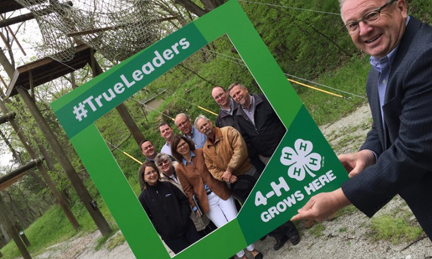
Several additional resources have also been shared statewide. With the support of the Nebraska 4-H Foundation and a donor, we were able to purchase a #TrueLeaders photo frame for each county office in our state; we also updated various print materials to include language from the campaign. The Nebraska 4-H Foundation also incorporated the 4-H Grows campaign language into its annual appeal letter.

The Nebraska 4-H Foundation and Nebraska Extension 4-H Youth Development is one of nearly 28 universities that is making a long-term investment in the 4-H Grows Engagement Campaign to build the brand and raise resources to help grow the 4-H program and positively impact more kids in the future. Can you tell us more about your marketing and alumni engagement plans in the coming months?

TP:  Nebraska 4-H has been working very closely with the Nebraska 4-H Foundation and its trustees to align our marketing communications efforts with the campaign. Last year using our 4-H enrollment system, we began asking if our current 4-H youth have a parent that was involved in 4-H as a young person. With this information, we identified the counties that have the highest percentages of current program participants who also have 4-H alumni parents. An online survey has been sent to these parents in order to provide us with information about their entry into the 4-H program. We are planning to use this input from current 4-H alumni parents to assist with our marketing efforts in connecting with new 4-H alumni parents next year.

The Nebraska 4-H Foundation has also been collecting alumni stories that will be used for promotional purposes. A letter is also being developed that will be distributed to 4-H alumni who connect with us through the state and national 4-H web sites.

Are you satisfied with the progress of this 4-H partnership and work to date?

TP:  Yes. The target market research conducted prior to the development of the campaign appears to have provided valuable direction for creative messages. The resources provided on the 4-H Marketing Online Resource Center have allowed us to focus more on the delivery of promotional messages, rather than the development of promotional messages and materials; I believe this provides our staff more time to focus on delivering positive youth development through 4-H.

What are you most excited about as it pertains to this new 4-H campaign?

TP: I’m excited that the 4-H messages we are sending through local, county, and state channels are contributing to a much larger national campaign. Our partnership effort will lead to a much more powerful, unified message.

We continue celebrating and highlighting 4‑H Mentoring programs across the country, and the mentors who have changed the lives of youth in their communities by serving as role models, educators, life coaches and friends. In our final installment, we’re featuring the 4‑H Tech Wizards Mentoring Program at the University of Vermont.

4‑H Tech Wizards is an after-school and in-school, youth mentoring program for underserved youth grades 4-12, that sparks youth interest in science, technology, engineering, and math (STEM) fields. Tech Wizards adult mentors are selected based on their experience in STEM fields and they teach kids about science and technology through project-based learning.

We chatted with Deborah Fajans, site coordinator and mentor in Westminster, Vermont, who shared her thoughts on the power of mentoring in the Tech Wizards program.

What is the main focus area of the program? What are its goals?

Deborah Fajans (DF): Tech Wizards is really a mentoring program, but we use science and technology as the hook to get culturally diverse, economically and physically at-risk children into our mentoring programs. Our main goal is to guide these children through tough times and making good choices for personal growth. During the science and engineering aspect of it, [the goals are] to develop skills, set a career path, and build self-esteem. It’s a great situation because they don’t know they’re being mentored, they don’t know that they are learning these science skills; it all happens in the context of fun.

What areas do you focus on most when mentoring a young person? Academics, career path, personal growth, etc.?

DF: My site is a residential school for children who are at-risk and cannot stay at home or are removed from the home. These children generally are confused or have low self-esteem, so the mentoring aspect of Tech Wizards is our number one priority. We also mentor in the context of science and engineering so academics is the next part. Tech Wizards is fused in every aspect of the school.

4htechwizards-mentor-3-1


Today, in many cases, youth development organizations have become the main source of mentorship and learning for young people, other than school learning. What does it take for families to become actively involved in a child’s upbringing, both during and after school?

DF: It is my belief that every family, parent or guardian is trying to do the best they can. I think families need training, meaningful ways to engage in their children’s experiences. I think the Tech Wizards program is right there, front and center, to provide that training. We may create activities for families to engage with their children, and we have family strengthening programs to help better mentor and nourish children. Tech Wizards’ training is culturally sensitive and responsive to what parents can and cannot give and we try to step in and train families to meet those needs for the children.

Share with us your most rewarding experience(s) as a mentor.

DF: On a personal level, I know that I’ve made a connection when I walk into a school and the faces light up. I also know when I’m making a connection when they come to me with their problems. I have learned to be totally receptive, to drop everything that I can and really listen. I can feel the connection because they have 100% of me, and I like that feeling.

I have a number of children that have gone on from the Tech Wizards program to use the science skills that they have learned and have set a career path for themselves.

4htechwizards-mentor-1-1


As a mentor, do you feel it is important to familiarize yourself with your mentee’s family/friends?

DF: I think it’s especially important, because many of the children at my site have been removed from their family. We have to work really hard to keep that connection going. We have Family Day, and I work really hard on those days. The school works very hard, and the child psychologists, to keep the mentors aware. I think many programs fail at these things because they have to flesh these issues out on their own. We train families to be better support systems, so it’s important to know the families.

Were you mentored as a young person? If so, who was your mentor and how did that person make a positive impact on your life?

DF: Well, I think everybody finds mentors along the way. Living one’s life – a child, even an adult – they need a roadmap. They may lose their way or they are in unfamiliar situations that there is always a need for a helpful friend or mentor to guide you through that. As a child, I can think of my high school English teacher [as a mentor]. I grew up in a small town and he encouraged us to be brave, to think about the bigger world, the bigger picture, and have the courage to go for it. I was mentored in my first job by a female supervisor who was vested in seeing young women make it up through the ranks. I’m even being mentored now by a university faculty member and Tech Wizards colleague who has been my guide for 14 years, helping me to achieve professionally. I owe a lot to that person.

In what ways do you think someone, at any age, can benefit from having a mentor?

DF: My philosophy is that mentors are everywhere, and they are needed often, in all stages of life. I think mentors can be a roadmap through life. You can’t know it all and solve all your problems by yourself. It takes a village to raise a child, and many mentors to get through life.

4htechwizards-mentor-4-1


In what ways do you think someone, at any age, can benefit from having a mentor?

DF: My philosophy is that mentors are everywhere, and they are needed often, in all stages of life. I think mentors can be a roadmap through life. You can’t know it all and solve all your problems by yourself. It takes a village to raise a child, and many mentors to get through life.

Do you think there should be a level of emotional preparedness?

DF: The Tech Wizards program has training for mentors. We have orientation sessions where we talk about ages and stages, where we train mentors on what to expect at different stages. A 7-year-old is going to look at a situation differently than a 13-year-old. We train a lot on the possible things that could happen.

What advice would you give someone interested in becoming a mentor?

DF: Well, I think they need to know that it is a very changeable journey. You can approach the mentorship thinking that you have these goals to achieve with your mentee but life kind of gets in the way, or changes it up. You need to be flexible. There are certain circumstances that may arise and you need to be there. You entered into this arrangement with this child that requires you to be focused and responsive. There may be instances where the mentee is calling the mentor for help, asking them to be there. If you don’t arrive, come early, or you don’t stay late during that time, you may miss some important signs and signals. That requires flexibility and learning on the mentor’s part.

We continue celebrating and highlighting 4‑H Mentoring programs across the country, and the mentors who have changed the lives of youth in their communities by serving as role models, educators, life coaches and friends. We are proud to feature the 4‑H Youth and Families with Promise (YFP) Mentoring Program at Virginia Tech.

4‑H YFP Mentoring – Virginia – The 4‑H YFP is a national program implemented to increase the developmental assets of youth and their families.

We spoke with Yvonne Earvin, Mentor Educator in Cumberland County, Virginia, who shared her thoughts and success of 4‑H YFP in Virginia and her personal insights.

What is the main focus area of the program? What are its goals?

Yvonne Earvin (YE): To help kids have a positive and personal relationship with caring adults in the community and to increase school attachment, providing positive experiences in connection to the school system. We look forward to youth succeeding academically.

4HYFP-3-1


What inspired the implementation of this program?

YE: We had so many challenges in our county and we wanted to provide extra support to young people.

Could you elaborate on those challenges?

YE: We saw young people that were in difficult situations with their families, dealing with social isolation, and underachieving in school despite being intelligent.

What areas do you focus on most when mentoring a young person? Academics, career path, personal growth, etc.?

YE: We have been working to explore social issues, problem solving skills, and encouraging fun. We also look for ways to connect families with the programs and to provide an additional support system.

Today, in many cases, youth development organizations have become the main source of mentorship and learning for young people, other than school learning. What does it take for families to become actively involved in a child’s upbringing, both during and after school?

YE: I think parent involvement is important and we have several activities that include parents. A lot of times, parents need the encouragement to be more active in their child’s life.

4HYFP-1-1


Share with us your most rewarding experience(s) as a mentor.

YE: I have one young man in our current YFP program that calls me on my cell, just to see how I’m doing. You really grow close with kids and this young man has always been full of hugs, which showed me that my work was appreciated.

Another young lady I worked with in the past before coming into this position had many personal challenges. She was able to graduate high school and attend college before ultimately becoming a deputy sheriff in Richmond. She calls me God mom. Her mother passed from a violent incident. When she started calling me God mom, it was unexpected but I didn’t stop it because of the attachment. I was shocked that she looked at me in this way.

As a mentor, do you feel it is important to familiarize yourself with your mentee’s family/friends?

YE: I believe so. I think it’s important that when families entrust their child with an organization that they feel comfortable with the relationship and the things that organization is doing for that child.

4HYFP-2-1


In what ways do you think someone, at any age, can benefit from having a mentor?

YE: I believe that at different points in our lives, we have different needs. Young people have different needs, like looking at college or dealing with career issues or family issues. Folks who have been through certain experiences can provide support to someone who is currently facing challenges.

Do you think there should be some emotional preparation?

YE: I would say yes, but the training we provide covers this, especially to make sure there aren’t any unresolved issues within mentors.

What advice would you give someone interested in becoming a mentor?

YE: I would say to get all the necessary information about the mentoring program, including the program goals and the type of activities. Get a clear understanding of the expectations before committing because once someone starts to look for you, the disappointment can be overwhelming.